What traceability means in Reqi
A requirement is never a row on its own. Each one carries the links that let you answer the questions a reviewer, a regulator or a supplier will ask: where it came from, which system owns it, who signed it off and what evidence closed it.
The flow-down alongside is the shape of it. A top-level requirement is derived level by level into subsystem and component requirements, each one linked to its parent, with the status of every link in view.
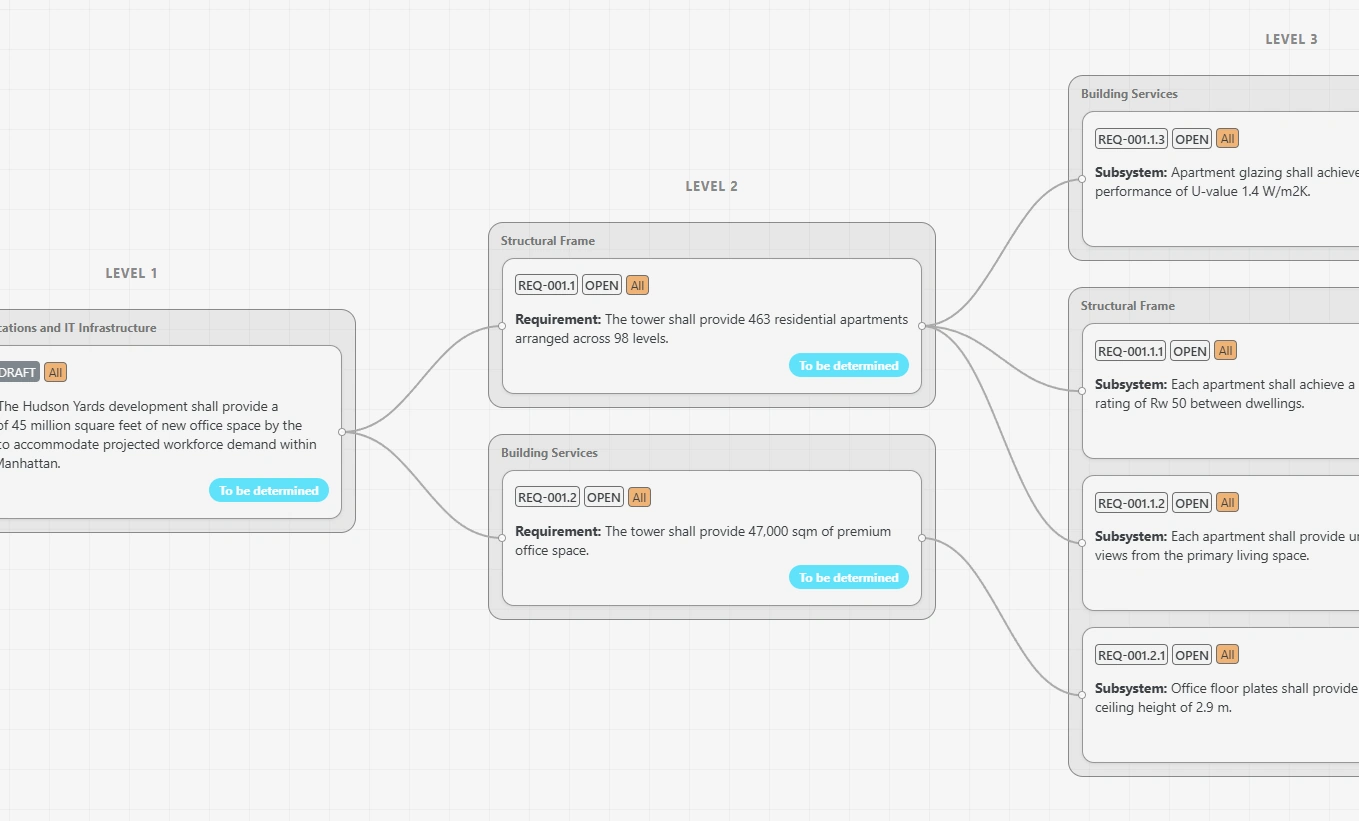
Parent and derived requirements
A business or stakeholder requirement flows down into system, subsystem and component requirements. Each derived requirement points back to its parent, so nothing is orphaned and every allocation is justified.
Allocation to systems
Every requirement is allocated to its place in the system breakdown structure. You can see what each subsystem owes, and which requirements have no home yet.
Owners and roles
Designers, reviewers and verifiers are named per system. The person who designs a requirement is rarely the one who signs it off, and the register records who did what.
Acceptance criteria and evidence
Acceptance criteria are defined against each requirement and the verification evidence is recorded with it, so closure is traceable to a document, a test or an inspection rather than to a tick in a cell.
Assumptions, constraints and dependencies
Risk sits beside the requirement it affects. The ACD register tracks assumptions, constraints and dependencies through the lifecycle with a risk level and an action plan.
Phases
Each requirement is tagged with its lifecycle phase, so a concept-phase requirement and a commissioning-phase requirement can be filtered, reported and verified at the right time.
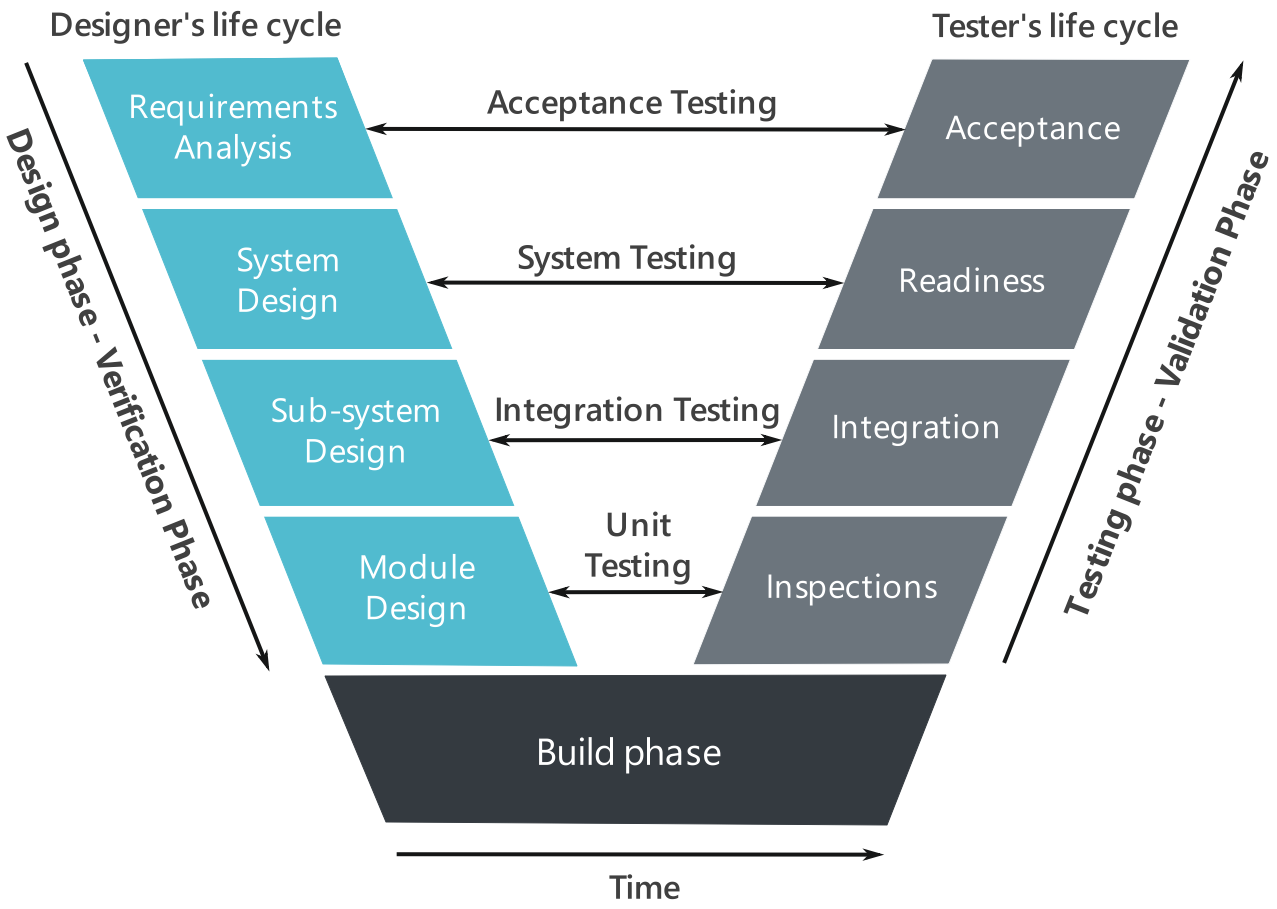
Up and down the V-model
Reqi is built on INCOSE systems engineering principles and tracks requirements through the whole V-model lifecycle. Forward traceability runs from a stakeholder need down through system and subsystem requirements to the component that satisfies it. Backward traceability runs from a test result or an inspection back up to the requirement it verifies and the need that justified it.
When a requirement changes, the chain shows what else changes with it. When a supplier asks why a requirement exists, the parent is one click away. The method behind this is set out in our requirements engineering framework; if you want the underlying ideas first, read what a traceability matrix is and how the V-model works.
Traceability across the supply chain
The hard part of traceability on a real programme is not the links. It is that the people who hold the evidence work for different organisations. Reqi gives the client, the contractor and every supplier one shared register with unlimited users, so a supplier records its evidence against the requirement itself rather than emailing a spreadsheet that someone then has to merge.
- Allocations go through review and are agreed before they lock, so a supplier cannot quietly re-scope what it owns.
- A team member who is not an approver can request an allocation change. The request shows as pending on the requirement until an approver agrees or declines it.
- Each role sees all systems or only its own, so a supplier sees the requirements it is answerable for and nothing it is not.
How the roles and the review states work is covered on the supply chain requirements management page.
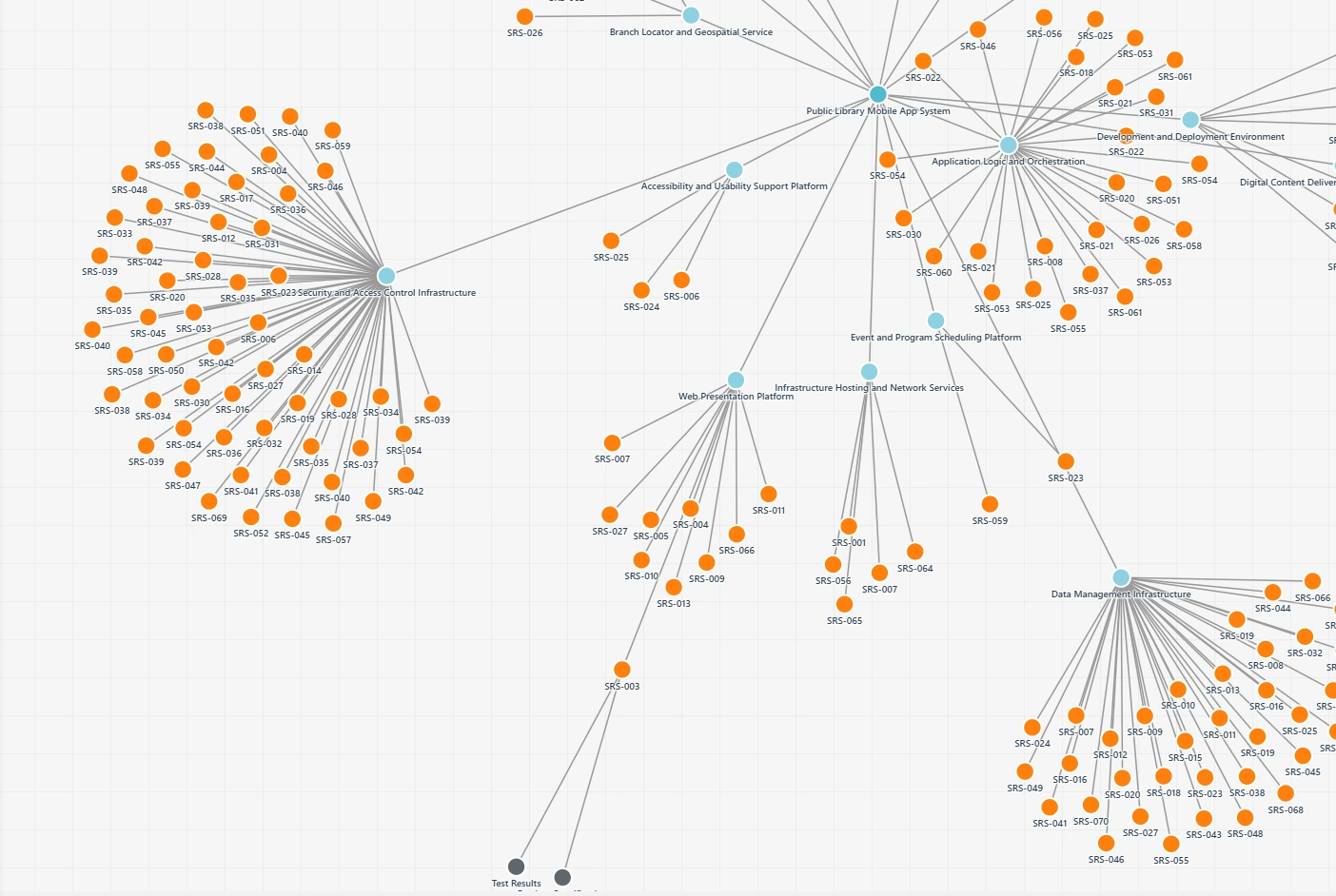
Risk, traced to the requirement it threatens
Assumptions, constraints and dependencies are tracked throughout the project lifecycle, each with a risk level and an action plan, and each attached to the requirements it affects. Safety requirements sit in the same register, from HAZOP and FMEA outputs through to verification evidence and safety case closure. There is a fuller description on the safety hazard management page, and a guide to the ACD register in the articles.

AI does the derivation, you do the review
Flowing a high-level requirement down through a deep system hierarchy by hand is where traceability usually breaks. REX, the AI assistant inside Reqi, derives subsystem and component sub-requirements from each parent and proposes the allocation level by level, as in the flow-down at the top of this page, so the chain is built as a proposal for you to review rather than left as a job for later. It also reads a PDF contract or specification and extracts a structured requirement list, so the top of the chain is populated from the source document instead of being retyped. The detail is on AI and MCP in systems engineering, and you can score a requirement in REX right now without signing up.
What it costs
$190 per month, plus GST
Per project, for one to five projects. Unlimited users on every plan, so every organisation in the chain can be in the register.
A single project is free for three months, up to 500 requirements, with unlimited users and no card. Full detail on the pricing page.
Requirements traceability: frequently asked questions
Is Reqi a requirements traceability matrix tool?
It produces what a traceability matrix is for, without you maintaining the matrix. Every requirement holds its parent, its derived requirements, its system allocation, its owner and its evidence, and the register can be viewed as a table, a tree or a network diagram and exported to Excel when a matrix is what the reviewer wants.
Can I import an existing set of requirements from Excel or Word?
Yes. Reqi imports requirements from Excel, CSV and Word files, and REX extracts a structured requirement list from a PDF. Parent links and system allocations are then set in Reqi, with REX able to propose them for review.
Does traceability extend to verification evidence?
Yes. Acceptance criteria are defined per requirement and the verification evidence is recorded against it, so a requirement is closed by a traceable document, test or inspection.
Does it cover safety requirements?
Yes. Safety requirements are managed in the same register as everything else, alongside assumptions, constraints and dependencies, from hazard identification through to safety case closure. See safety hazard management.
How is it priced?
$190 per month plus GST per project, with unlimited users. A single project is free for three months with up to 500 requirements.
Start with one project
Three months free, 500 requirements, unlimited users, no card. Or score a requirement in REX right now without signing up.
Get started free Book a demo