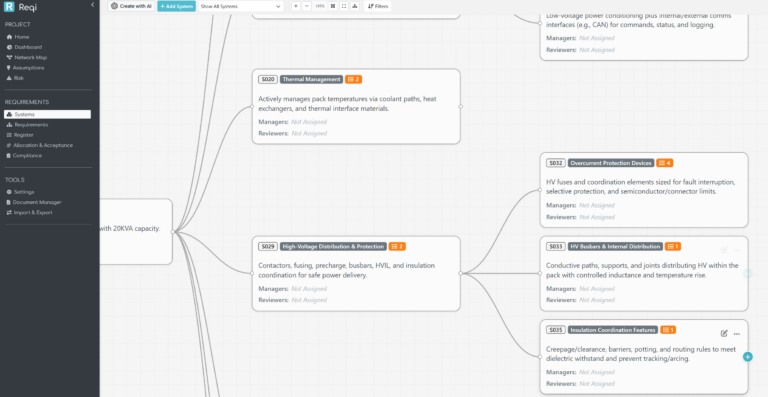
The Digital Thread in Systems Engineering, Explained
On a complex programme, the “truth” about the system is scattered — requirements in one tool, the design model in another, test results in a third, operational data somewhere else entirely. Ask “what does this change affect?” and you are in for a day of detective work. The digital thread is the fix: a connected flow of data that links every stage of a system’s life — requirements, design, analysis, verification and operations — so they reference one another instead of sitting in silos.
It is one of the central ideas in the future of the discipline, and model-based systems engineering is increasingly its backbone. Here is what the digital thread is, how it differs from a digital twin, and how to start building one.
Table of Contents
What the Digital Thread Connects
| Lifecycle stage | What it contributes to the thread |
|---|---|
| Requirements | What the system must do, linked to everything downstream |
| Architecture & design | The model of how it is built |
| Analysis & simulation | Performance and trade-off results tied to the design |
| Verification & test | Evidence each requirement is met |
| Operations | Real-world data feeding back into the model |
What Is the Digital Thread?
The digital thread is the set of connections that lets data flow across a system’s entire lifecycle. Instead of each phase producing documents that go stale the moment the next phase starts, every artefact — a requirement, a design element, a test result — is linked, so you can follow any thread forward to where it is used and backward to where it came from. It is traceability raised to the level of the whole enterprise.
Digital Thread vs Digital Twin
They are often confused. A digital twin is a live virtual model of a specific physical asset, fed real data. The digital thread is the connective tissue — the data links that run through the whole lifecycle. Put simply: the twin is a thing; the thread is how everything about that thing stays connected.
MBSE Is the Backbone
A digital thread needs an authoritative model at its centre, and that is exactly what MBSE provides. The shift to SysML v2, with its standard API, is what finally makes the thread practical: the system model becomes a service that requirements tools, simulations and verification can all connect to, rather than a file you export and lose fidelity from. Serious MBSE implementation and the digital thread are really the same journey.
The Payoff: Change Impact and Shift-Left
Two benefits stand out. First, change impact: change one requirement and the thread shows you every design element, test and artefact it touches, in seconds rather than a day. Second, shift-left: because operational and test data link back to the model, you can catch problems far earlier, when they are cheap to fix.
Getting Started
You do not build a digital thread in one leap. Start by connecting two phases that currently hurt — usually requirements to verification — with real, tool-to-tool links, prove the value, then extend. The model, the tooling, and the discipline grow together.
A Worked Example: Change Impact in Seconds
The clearest payoff is a question every programme dreads: “if we change this requirement, what does it break?” Without a thread, an engineer spends a day combing documents and asking around, and still misses something. With a digital thread, you change the requirement and immediately see every linked item light up — the design elements that implement it, the tests that verify it, the analyses that assumed it, even the supplier deliverable that depends on it. A day of detective work becomes a few seconds of querying the model.
Where Teams Actually Start
Nobody builds a full digital thread in one go. The pragmatic entry point is to connect the two phases whose disconnection hurts most — almost always requirements and verification. Link each requirement to the test that proves it with real, tool-to-tool links, demonstrate that you can answer “is every requirement tested?” instantly, and use that win to justify extending the thread to design, analysis and operations.
The Maturity Curve
Think of it as a curve. At the bottom, tools are islands and integration is manual copy-paste. In the middle, key links are automated — requirements to design, design to test. At the top, a single connected model serves the whole lifecycle, and the SysML v2 API lets every tool reach into it. Most organisations are somewhere in the middle; knowing where you sit tells you the next link worth automating.
Frequently Asked Questions
What is the digital thread in systems engineering?
The digital thread is a connected flow of data that links every stage of a system’s lifecycle – requirements, design, analysis, verification and operations – so artefacts reference one another instead of sitting in disconnected silos. It enables instant change-impact analysis and end-to-end traceability.
What is the difference between a digital thread and a digital twin?
A digital twin is a live virtual model of a specific physical asset, updated with real data. The digital thread is the connective tissue that links data across the whole lifecycle. The twin is a thing; the thread is how everything about it stays connected.
How does MBSE relate to the digital thread?
MBSE provides the authoritative system model at the centre of the digital thread. With SysML v2’s standard API, that model becomes a service other tools connect to, making the thread practical rather than a manual integration effort.
Related guides
- Digital twins in systems engineering — the related concept
- What is MBSE? — the backbone
- SysML v2 — what makes the thread practical
- What is a traceability matrix? — traceability, scaled up